Beyond Context Bias: Adaptive Instance Placement for Robust 3D Instance Segmentation

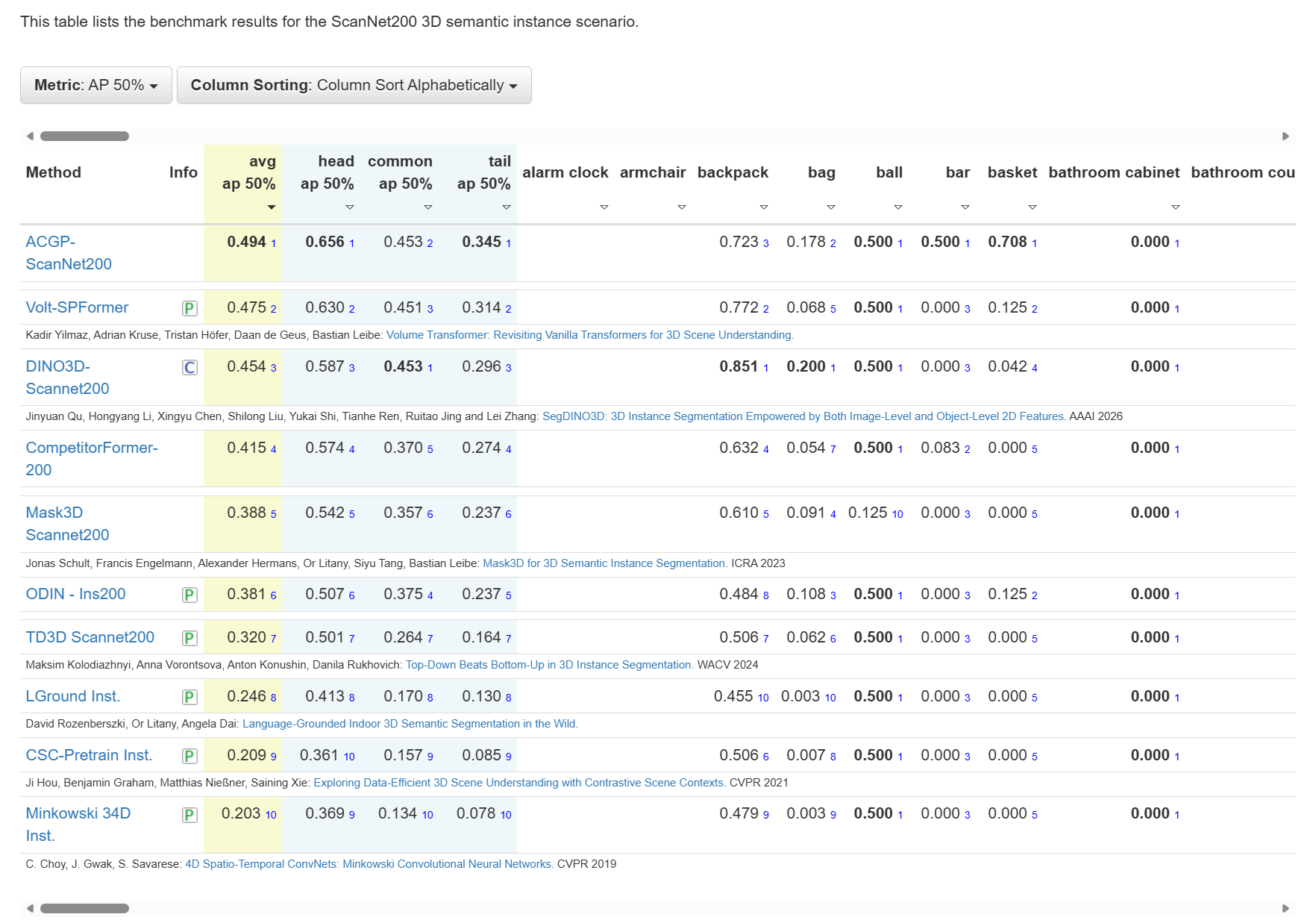
Our method achieves new state-of-the-art performance on the ScanNet200 and ScanNet++ test benchmark
Rongkun Yang1, Ye Zhang1, Longguang Wang1, Zhiheng Fu2, Lian Xu1, Yulan Guo1*
1 Spatial Artificial Intelligence Lab , Sun Yat-sen University    2 The Spatial Intelligence Group, Hong Kong Polytechnic University, HKSAR,   

Abstract

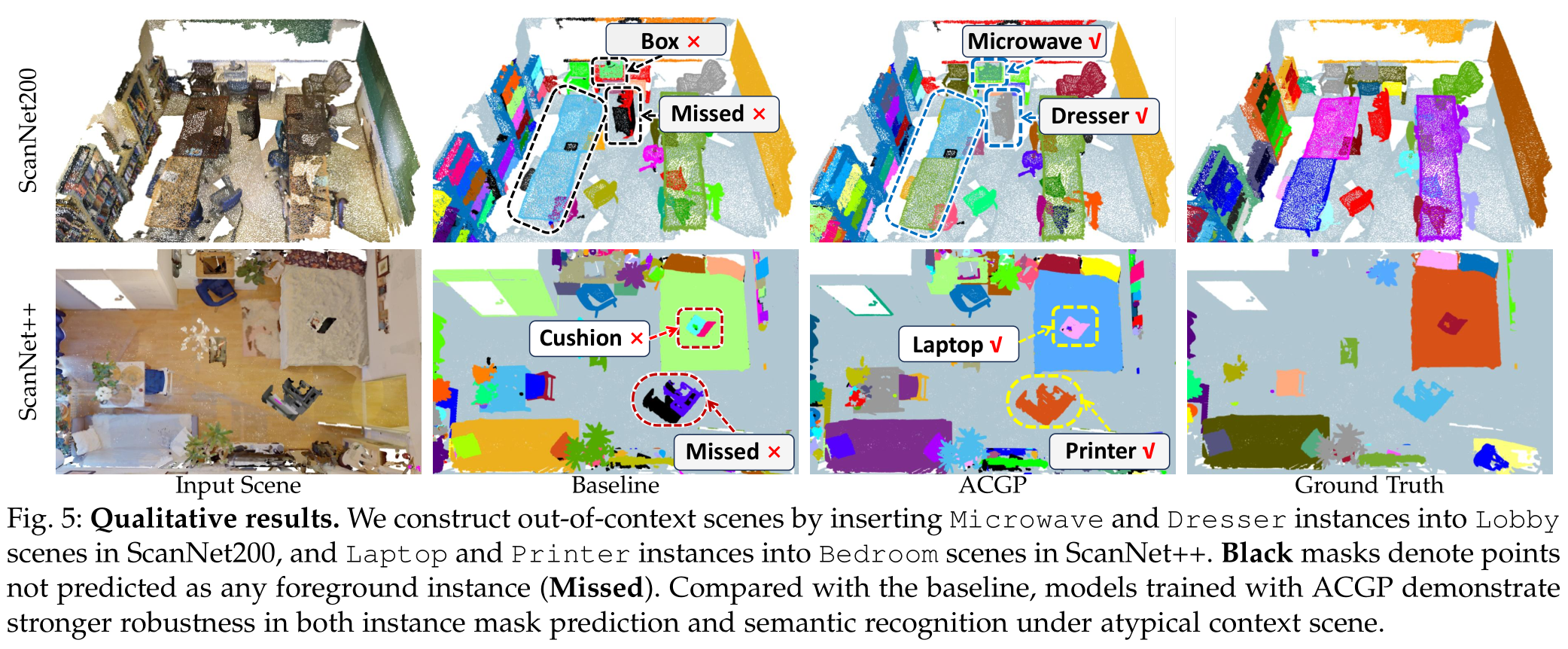
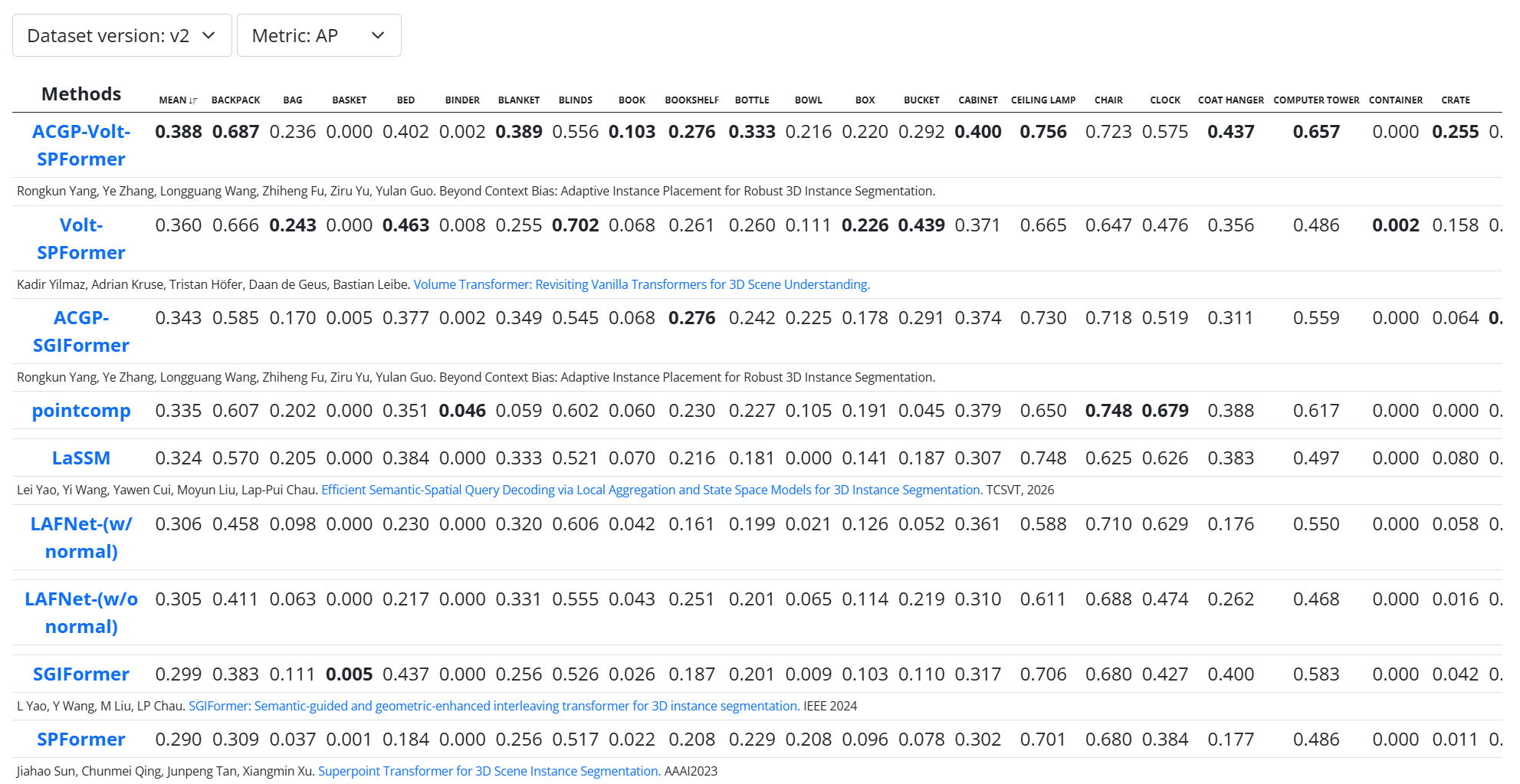
3D instance segmentation aims to identify and segment individual object instances in complex 3D scenes, forming a key foundation for scene understanding and embodied interaction. However, existing methods are typically trained on captured static scenes, where object categories are naturally tied to their surrounding contexts. This induces biased category--context associations: most object categories are often coupled with limited scene contexts, with even narrower contextual coverage for underrepresented categories in long-tailed real-world distributions. Consequently, models may overfit to frequent contexts and generalize poorly to uncommon object--scene layouts. To address this, we propose ACGP, an Adaptive Context- and Geometry-aware Instance Placement framework for robust 3D instance segmentation. ACGP decouples instances from their source scenes and relocates them into diverse yet geometrically plausible target contexts, thereby enriching object--scene contexts beyond dataset-specific layout priors. Additionally, we further incorporate adaptive class-balanced sampling to increase the exposure of underrepresented categories during augmentation. Through efficient context- and geometry-aware placement, ACGP preserves plausible scene geometry and achieves over 300$\times$ faster instance insertion than conventional collision-detection-based methods. Extensive experiments on multiple 3D instance segmentation benchmarks and architectures show that ACGP consistently improves segmentation accuracy and robustness, especially under uncommon object--scene layouts. ACGP establishes new state-of-the-art results on both the ScanNet++ and ScanNet200 test benchmarks, achieving mAP scores of 38.8 and 38.1, respectively. Code is available at: https://github.com/SYSU-SAIL/ACGP
Motivation

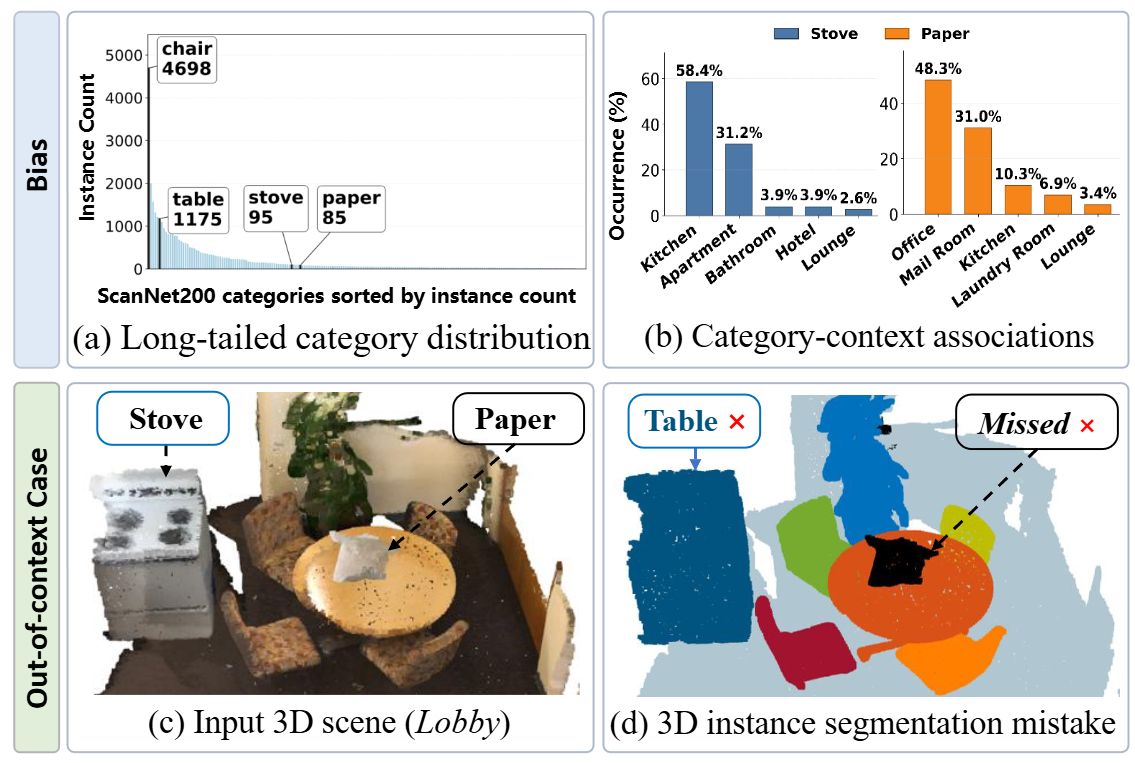
ACGP motivation
Motivation. Limited contextual diversity and long-tailed category distributions in static 3D scene datasets induce biased contextual priors, leading to contextual overfitting and failures in atypical out-of-context cases for 3d instance segmentation. ACGP decouples instances from their source scenes and adaptively relocates them into diverse yet geometrically plausible target contexts, thereby enriching object--scene contexts beyond dataset-specific layout priors.

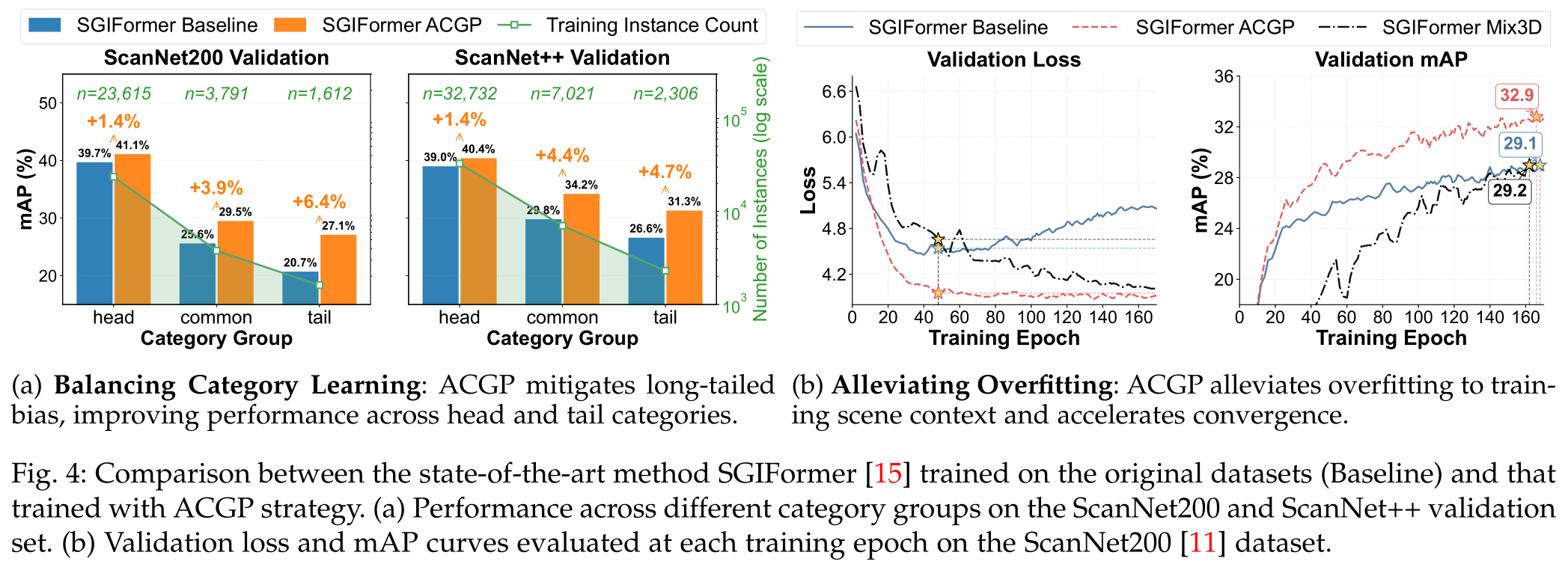
Method Effectiveness

(a) Balancing category learning (b) Alleviating contextual overfitting
Method Effectiveness

Overall Pipeline

method

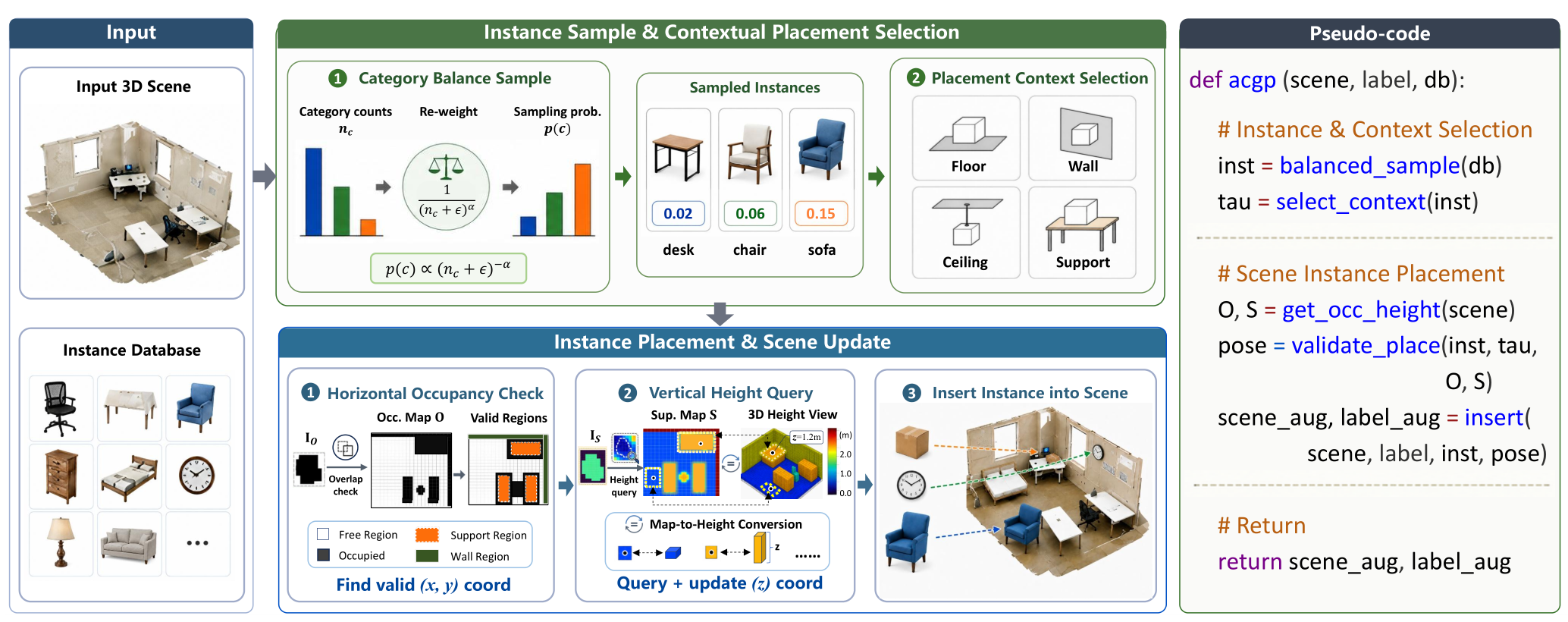
Overall framework of ACGP.. Given a 3D scene and an instance database, ACGP selects instances via category-balanced sampling, queries their category-conditioned placement types, and places them at geometrically valid locations using occupancy- and support-aware validation to generate augmented scenes. The pseudo-code on the right summarizes the complete pipeline of instance-level augmented scene generation.

Experiments

ScanNet++ Test Benchmark Result

method

ScanNet200 Test Benchmark Result

method

Qualitative Results

Qualitative Results

BibTeX

@misc{yang2026acgp,
  title  = {Beyond Context Bias: Adaptive Instance Placement for Robust 3D Instance Segmentation},
  author = {Rongkun Yang, Ye Zhang, Longguang Wang, Zhiheng Fu, Lian Xu, Yulan Guo},
  year   = {2026},
  url    = {https://github.com/SYSU-SAIL/ACGP}
}